
One of the most expensive questions a small-budget advertiser can ask is:
Which ad is most likely to win?
It sounds responsible. You have limited money, you can’t test everything, and you want to put your budget behind the strongest idea.
The problem is that the question asks planning to do something it can’t reliably do: know the market’s answer before the market has answered.
That changes the job of pre-test thinking. Instead of choosing the candidate that currently deserves to go first, you try to predict which candidate will ultimately perform best. Those are different tasks.
The distinction matters most when your budget is small.
A large advertiser may be able to launch several materially different angles, collect enough data, and let the weaker ones fall away. A smaller advertiser may only have enough budget to give one or two ideas a meaningful test. That constraint creates pressure to be certain.
But limited budget doesn’t make prediction more accurate. It makes prioritization more important.
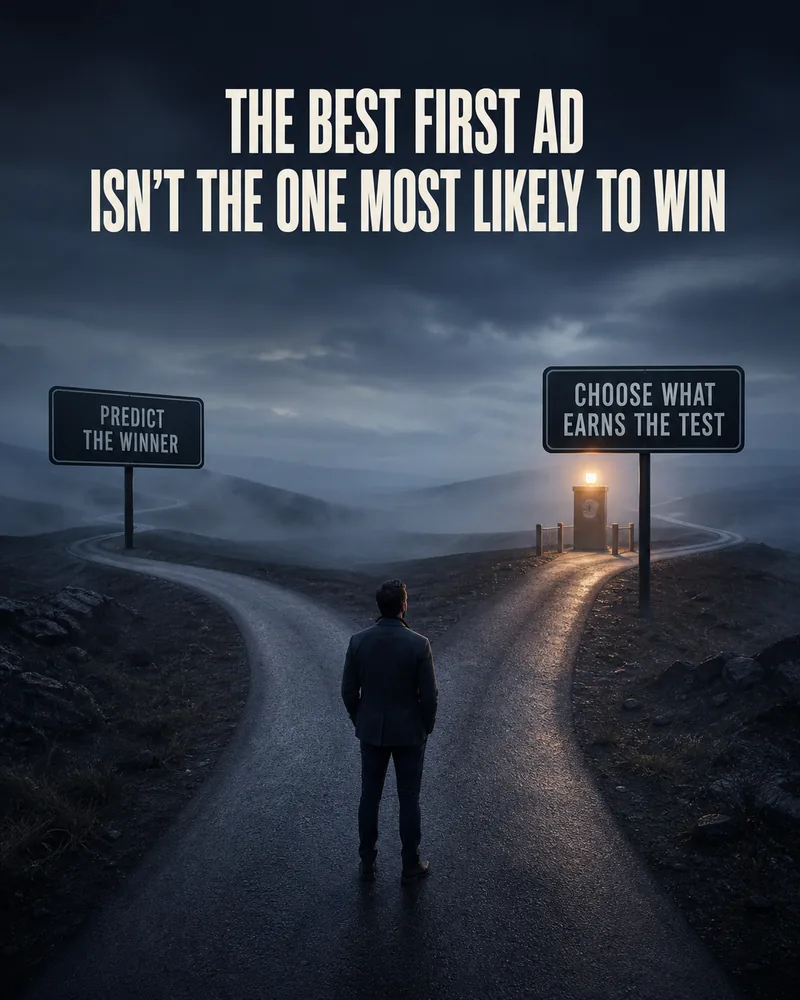
Your first ad is not your prediction of the winner. It is your best current candidate for earning the next piece of information.
Prediction asks too much from the evidence
Before an ad runs, you’re working with incomplete information.
You may understand the customer’s pain, know the offer well, and have useful experience from previous campaigns. You may even have strong evidence that certain messages resonate.
All of that can improve your judgment. None of it tells you exactly how this audience, offer, angle, creative execution, placement, and moment will interact once money is behind the ad.
That missing information is what testing is supposed to provide.
Advertisers often try to eliminate the uncertainty before testing. They compare five angles, choose the one that feels most emotional, favor the cleverest headline, or ask an AI tool which idea is “most likely to convert.” They keep refining until one concept feels convincing enough to launch.
At that point, the test stops being a way to discover something. It becomes a ceremony for proving a prediction.
The cost shows up in two ways. Small differences between candidates begin to feel more meaningful than the available evidence supports. Then attachment sets in. Once you’ve declared an idea the likely winner, a weak result feels like failed judgment instead of useful information.
A better mental model separates two questions:
Prediction: Which ad will win?
Prioritization: Which ad has the strongest case for going first?
The first requires information you don’t yet have. The second can be answered with the information you do have.
Build a case, not a prophecy
Suppose you sell bookkeeping software for freelancers and solo business owners. You’re considering three ad angles.
The first focuses on pain:
Still sorting receipts at 10 p.m. because your books are a mess?
The second focuses on an outcome:
Know what your business actually earned before tax season forces you to find out.
The third addresses an objection:
Bookkeeping software doesn’t have to turn you into an accountant.
Which one is most likely to win?
You don’t know. Anyone who gives you a confident answer without relevant campaign evidence is adding certainty the situation doesn’t contain.
You can, however, decide which angle deserves to go first.
The pain angle describes a recognizable frustration, but the message may be fairly broad.
The outcome angle connects to a financially meaningful desire, but it may be a weaker fit if the product is positioned primarily around simplicity rather than financial reporting.
The objection angle could be especially relevant if the intended buyer wants organized books but resists accounting tools because they expect them to be complicated.
That comparison doesn’t tell you what will happen. It tells you which candidate currently has the best-supported reason to go first.
A useful first-ad decision can be built around five questions:
- Does the angle connect to a meaningful buyer problem or desire?
- Is the message specific enough to mean something?
- Is it materially different from the other available angles?
- Is there a credible reason to believe its claim or premise?
- Does it lead naturally into the offer?
These are evidence questions, not scoring theater. Their purpose is not to manufacture mathematical certainty. Their purpose is to stop preference from masquerading as strategy.
If the objection angle reflects a credible buyer concern, clearly differs from the alternatives, can be supported by the product experience, and leads directly into the product’s ease-of-use positioning, it may have the strongest current case.
That makes it the provisional leader.
Provisional is the important word.
Based on what we know before the test, this candidate deserves the first opportunity to prove or disprove its case.
You are not saying, “This is the ad that will win.”
That difference changes how you respond to the result.
If the provisional leader performs well, you have evidence that the case may have been directionally right. If it performs poorly, you haven’t discovered that your marketing judgment is broken. You’ve learned that the pre-test case did not translate into the market response you wanted under those conditions.
Now you can investigate why. Was the angle weak? Was the audience mismatched? Did the creative execution fail to express the angle? Was the promise unconvincing? Did the offer fail to support it? Does another candidate now deserve the next test?
This is how limited-budget testing becomes cumulative learning instead of a sequence of emotional bets.
The first test should reduce uncertainty
The provisional-leader idea gives you a second decision rule for situations in which two candidates appear equally strong.
Don’t ask only which one looks better. Ask:
Which test would teach me more?
Return to the bookkeeping company. Suppose the outcome angle and the objection angle both have credible cases.
The company already knows from customer conversations that freelancers want better visibility into their finances. Testing the outcome angle may reinforce something the team already believes.
What the company doesn’t know is whether fear of complexity prevents prospects from trying bookkeeping software at all.
Testing the objection angle first could have greater informational value. If it works, the company has uncovered a useful message direction. If it doesn’t, the result weakens a hypothesis that might otherwise keep influencing future campaigns.
The best first test is not always the ad with the highest apparent upside. Sometimes it is the one that resolves the most important uncertainty.
That gives you a reusable thinking device:
Strength of case × value of learning
It doesn’t need to become a literal formula.
First, identify the candidates with a defensible case based on what you currently know. Then, among those candidates, ask which result would most improve the next decision.
Testing a weak idea merely because the result would be interesting is not disciplined experimentation. A first candidate still needs a real case. But repeatedly testing variations of what you already believe may produce activity while adding little useful knowledge.
A limited budget cannot afford random experimentation, but it also cannot afford meaningless certainty. Each test needs to earn its place.
Keep planning and testing in their proper roles
Treating the first ad as provisional also changes how you behave after launch.
When you believe you’ve chosen “the winner,” weak early performance creates panic. You start changing the headline, audience, creative, landing page, bid, and offer because reality isn’t cooperating with your prediction. Soon, you can no longer tell what the test actually tested.
When you’re testing the strongest current hypothesis, weak performance is information. Your responsibility is to give the test a fair opportunity, gather enough evidence to make a useful judgment, and update the hypothesis when the result earns that update.
Planning decides what deserves to be tested. Testing supplies information planning didn’t have. The next decision is then made with a better information set. The advantage comes from repeating that cycle without confusing a well-reasoned starting point for a guaranteed outcome.
A small advertiser doesn’t need to identify the winning ad in advance. They need to avoid wasting the first test on a poorly reasoned candidate while remaining flexible enough to let the result change their mind.
So when several angles are competing for a limited budget, stop asking:
Which one do I think will win?
Ask:
Which candidate has the strongest case with the evidence I have right now?
Then ask:
Would testing it meaningfully improve what I know next?
Choose that candidate as the provisional leader. Give it a fair test. Then let the market contribute the part of the decision you were never supposed to know in advance.
Planning chooses the best-supported hypothesis. Testing earns the right to replace it.
Turn the idea into your next test
Want a practical way to compare your possible angles? Start with the First-Angle Guide for the complete decision process, or use the AI Ad Angle Map to develop stronger candidates before choosing what earns the first test.
Choose Which Ad Angle Has Earned the First Test
Use the tool below to compare your candidate ad angles without pretending you can predict the winner. Your answers stay in your browser. The tool will build a personalized prompt you can copy into ChatGPT or Claude.
Ad-Angle Prioritization Prompt Builder
Structure your angles, target audience, and real evidence into an objective AI prompt that identifies which test has earned priority.
Runs completely in your browser. No data is stored or transmitted.